Technical Comparison of E-Cigarette Aerosol Generation vs. Conventional Smoke Yield and Measurement Challenges
The paradigm shift from "combustion" to "atomization" is reshaping the measurement logic of tobacco science. This article compares e-cigarette aerosol with conventional smoke in terms of mass, particle size, and measurement challenges.
0.1–5 μm
Typical range of the mass median aerodynamic diameter (MMAD) of e-cigarette aerosol
60%
Laboratory humidity threshold above which aerosol particle coalescence is significantly enhanced
PG / VG
The two basic components with the highest content and strongest volatility in e-cigarette liquid
MMAD
Mass median aerodynamic diameter (MMAD), the core indicator used to assess the particle size distribution of e-cigarette aerosol
In tobacco science, the paradigm shift from "combustion" to "atomization" is not merely a change in the heating method; it is a fundamental restructuring of the mechanism by which substances are released. For a long time, the industry has been accustomed to assessing smoking exposure through the concept of "smoke yield." However, when we try to apply this yardstick to e-cigarette aerosol, we find that the existing physical model and measurement logic are facing unprecedented challenges.
The Discrepancy Between Mass and Volume: From "Residue" to "Suspended Droplets"
The evaluation logic of conventional cigarettes is relatively straightforward: gravimetric analysis is used to measure the ash and residue left after a single cigarette is burned. This measurement method, based on "mass loss," essentially measures the collection of solid and liquid products produced by incomplete combustion.
In contrast, the essence of e-cigarette aerosol is suspended droplets formed when liquid substances undergo a phase change under thermal energy. Here lies a core technical contradiction: the dynamic nature of mass. In conventional smoke, because most particulate matter is solid or a low-volatility liquid, its mass remains relatively stable during sampling; but in e-cigarette aerosol, many components — such as propylene glycol (PG), vegetable glycerin (VG), and various flavoring ingredients — are highly volatile.
In multiple comparative tests in the laboratory, we observed a phenomenon: if the traditional gravimetric method is used alone, the measured aerosol mass often turns out to be significantly lower due to "secondary evaporation" during sampling. This measurement deviation is not caused by insufficient output from the product itself, but rather because we are attempting to capture a "highly dynamic" suspension system with a "static" measurement logic.
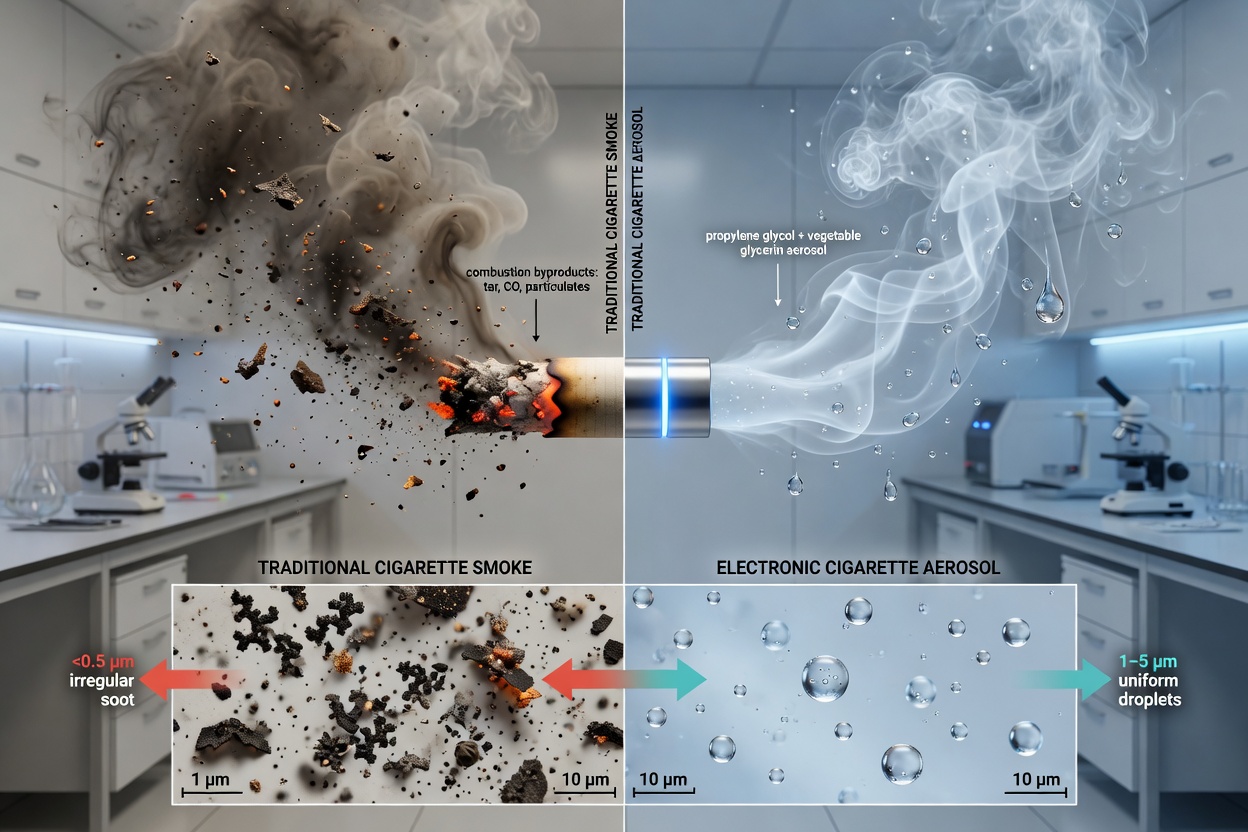
Conventional smoke
Products of incomplete combustion: mostly solid or low-volatility liquids, with an extremely wide size distribution and large numbers of sub-micron ultrafine particles.
E-cigarette aerosol
Controlled phase-transition products: suspended droplets with highly volatile components, with MMAD concentrated between 0.1 and 5 μm.
Differences in Particle Size Distribution: A Fundamental Distinction at the Microscopic Scale
From the perspective of particle size distribution, the two differ enormously. Conventional smoke contains large numbers of sub-micron ultrafine particles, with an extremely wide size distribution that is strongly affected by combustion temperature.
By contrast, the particle size of e-cigarette aerosol is mainly controlled by the structure of the atomizer coil, the power, and the viscosity of the liquid. Current measurement data indicate that the mass median aerodynamic diameter (MMAD) of e-cigarette aerosol typically falls between 0.1 μm and 5 μm. This means that e-cigarettes produce a relatively "coarse" collection of droplets, whereas conventional smoke contains many extremely fine particles that can penetrate deep into the alveoli. This difference in size distribution directly leads to the incomparability of the two systems when assessing their biological effects.
Measurement Challenges: The "Disappearing Mass" in the Laboratory
In actual R&D and testing work, measuring aerosol quantity is by no means easy. The main difficulties currently concentrate on the following three dimensions:
- 1. The Trade-off Between Sampling Efficiency and Volatile Loss: When using a cascade impactor for particle size classification, the longer particles remain on the impaction plates, the greater the likelihood that volatile components will be lost. As a result, during size-segregated measurement we often find that mass loss in the smaller size ranges is far greater than in the larger ranges, artificially "distorting" the particle size distribution curve.
- 2. Sensitivity to Environmental Conditions: In a test conducted under different ambient humidity levels, I observed that when laboratory humidity exceeds 60%, the coalescence of aerosol particles is significantly enhanced. This phenomenon not only changes particle size but also indirectly affects the sampling efficiency of the measuring equipment by altering the surface tension of the droplets. This environmental coupling effect makes it extremely difficult to establish a standardized, reproducible measurement protocol.
- 3. The Contradiction Between Real-Time Monitoring and Integral Measurement: Although an optical particle counter (OPC) can provide real-time concentration data, it relies on the principle of light scattering and is extremely sensitive to color, refractive index, and multiple scattering effects at very high concentrations. To obtain accurate total mass, on the other hand, long-term integral sampling is required, and there is a natural logical gap between these two technical approaches.
Personal Observation: The Urgency of Standardization
While participating in the discussion of several industry standards, I have consistently believed that we should not simply equate e-cigarette output with "smoke yield."
In a test of a certain new heat-not-burn product, we found that although its aerosol mass concentration appears numerically comparable to conventional smoke, its deposition pattern in the human respiratory tract is completely different because of the extremely high volatility of its components and the highly concentrated particle size distribution. If we conclude that "exposure is similar" merely because "the numbers are close," that would be scientifically unsound.
We urgently need a comprehensive evaluation system that simultaneously takes into account the three core dimensions of "mass, particle size, and volatility rate," rather than remaining stuck at a single gravimetric or counting level.
Conclusion
The comparison between e-cigarette aerosol and conventional smoke is, in essence, a comparison between "complex combustion products" and "controlled phase-transition products." The existence of measurement difficulties does not mean that technical means are lacking; rather, it reminds us that when facing this new type of substance system, we must establish entirely new physical models and testing paradigms.